Monday, September 18, 2017

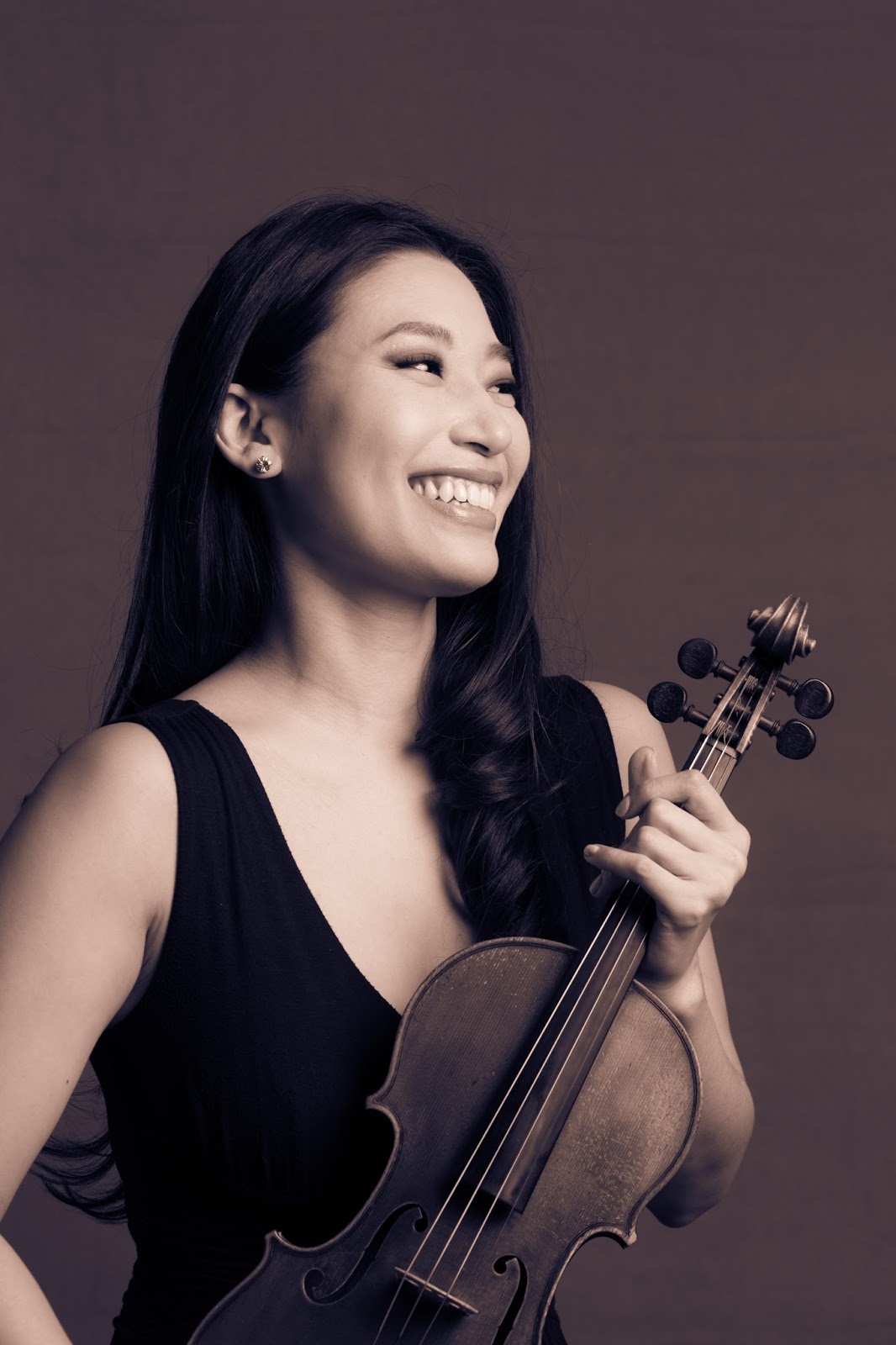
Meet the Musician Monday: Violinist Michelle Kim

Photography by Danielle Cho

Where did you grow up and what made you choose violin? 

I was born in Seoul, South Korea and moved to Los Angeles when I was 10. My mom grew up listening to classical music and started me on piano lessons when I was five. After a few months, she switched me to violin so I could play duets with my older sister who had already been playing the piano for a year.


Where did you get your musical training?  When did you know you wanted to be a professional musician?

I didn’t take a straight path to becoming a professional musician. Growing up in LA, I took lessons with Laura Schmieder at Colburn School and played for the Colburn Chamber Orchestra every Saturday. But by my junior year in high school, my family decided that I should give up the violin to prepare for college and a traditional career.

Even though I hadn’t played for two years, I still brought my violin to UC Berkeley. I knew that music could open many doors in life, including traveling to performances, meeting people, learning different cultures and building lasting friendships.

I got a degree in statistics while playing in the University Symphony for four years.   I also gave recitals on and off campus with faculty members and fellow student musicians, and was a soloist with the orchestra for two separate performances after twice winning the orchestra’s concerto competition.

Through David Milnes, the Music Department Director and University Symphony Conductor, the University Music Department paid for my lessons with Zoya Leybin, a San Francisco Symphony member and a faculty of the SF Conservatory.  In the beginning of my senior year, just as I was putting my violin away for good to focus on finishing school and looking for a job, David convinced me that I had a future in music and encouraged me to follow my passion. We discussed career options in music and, on that day, I decided to become a professional musician! 

I spent the next several months applying to conservatories and decided to get a Master’s Degree in Music at Manhattan School of Music to study with Laurie Carney, a founding member of the American String Quartet. The summer after I graduated from MSM, I was very lucky to win a position in the first violin section in the Kennedy Center Opera House Orchestra! 


Could you name any favorite artists you’ve worked with or productions you’ve performed in since being in the orchestra?

I am extremely fortunate to have worked with Placido Domingo at the Washington National Opera.  He has brought so much passion and beauty to our music.  He was – and still is -- a great inspiration in my career and in my life.

with Maestro Domingo at intermission
I enjoy working on the standard opera and ballet repertoire and also love playing new music.  I was especially moved by playing The Little Mermaid ballet by John Neumeier and Lera Auerbach this past season. And I found Jake Heggie’s opera Dead Man Walking compelling and satisfying.  I also saw Miami Music Festival’s performance of this opera this past summer.   
 

Do you perform outside of the Kennedy Center?

Quite often.  Four years ago, I started to play the electric violin and perform different genres of music such as rock, crossover, EDM and adult contemporary.  I also do some composing/arranging/covering. 

Playing various types of music and in different Kennedy Center productions (Kennedy Center Honors, gala concerts, etc.) -- and working with talented orchestra colleagues -- inspired me to find my own sound. 

Some of my cool electric violin gigs include performing at the Peace Institute for then Defense Secretary Chuck Hagel and Korean National Defense Minister Han Min-Koo, at the IMF Annual Meetings in DC, and at the National Association of Health Underwriters Capitol Conference.

Performing in a recital at the
In Spiritum Music Festival in Portugal
Performing for the IMF Annual Meetings
Performing at the MGM National Harbor
Grand Opening private event, Dec. 2016
This is a short demo/music video of my performance at the Italian Embassy in DC for Becky’s Fund Walk This Way fundraising fashion show. 


Recently, I performed my own composition Con Spero at the United Nations Headquarters in New York celebrating the UN General Assembly’s passing of the new International Name Day for Micro, Small, and Medium Sized Enterprises. 

Michelle performing her composition Con Spero at
the UN Headquarters in NY

What has been the most inspiring concert experience since being in the KCOHO?

The most inspiring concert I’ve played at the Kennedy Center was in 2012 with visiting musicians from Tunisia to commemorate the Jasmine Revolution in their country.  It was a side-by-side concert with Kennedy Center orchestra musicians as we all performed Hannibal Barca, a symphony written by a Tunisian composer.  I started a humanitarian organization, Culture Saves, after seeing and feeling this music bring hope and inspiration to the audience and to the musicians.  Culture Saves connects artists from around the globe and enables them to find commonalities in different cultures, and to help restore hope and promote peace in areas of conflict through the arts.

with Tunisian Violist, Mourad Frini

Do you have any hobbies outside of the orchestra?

I picked up squash (the game and not the fruit!) several years ago at my gym in DC. I’ve participated in amateur squash tournaments and camps in the DC area, San Francisco, Rye (New York), Baltimore and France.  And I like to prepare things that I enjoy eating – such as simple Italian dishes, sushi and Korean food.  I also love movies, especially sci-fi and independent films. And I’m thinking seriously of getting a dog…    

playing in a squash tournament

In the recent past, you severely injured your hand. What was it like coming back from an injury like that, and how has it changed your playing? Any advice to other musicians recovering from injuries that require time off their instrument?

Two years ago, I broke my left (fingerboard) hand in a car accident. I had two surgeries during the following year and months of occupational therapy.  A serious hand injury like this can often end a violinist’s career.  I was broken physically and mentally and spent months moping around.  Eventually, I accepted the fact that it would take time before I could play again (if at all!). So I focused on things I couldn’t do before when I was working as a full-time violinist.  When you’re displaced from your passion and your career, it’s important to put your energy into other interests that you weren’t before able to fully develop. With this philosophy and this attitude, I organized events for Culture Saves with visiting artists from around the globe. I also participated in other volunteer projects in the Washington area.  When my hand finally healed and regained its strength and motion, I was able to return to my career as a performer… with a new perspective and appreciation for my work.  
 

What do you most look forward to playing this season?

I look forward to working with our Music Director Philippe Auguin in Don Carlo later this season.  Maestro Auguin always brings a robust but sensitive, and an elegant but modern, interpretation to every piece of music. 

with Maestro Auguin
And a week from today (Monday, September 25), I’ll be performing the Debussy Trio on the Millennium Stage with two gifted musicians - KCOHO cellist Igor Zubkovsky and pianist Grace Eun Hae Kim. 

In November, Washington National Opera is performing Handel’s baroque opera Alcina for the first time.  Although Handel wrote over 40 operas, the last one that WNO performed was Tamerlano in 2008 with Placido Domingo, David Daniels, and Sarah Colburn.  I’m thrilled to be playing in Alcina, especially since I’ll be on stage in full costume playing the solo violin part with the Morgana character in Act II.  I’ve been performing on stage since I was seven, but I’ve never performed on an opera stage before! There will be seven performances of Alcina.     

Currently, I’m enjoying our run of Verdi’s Aida.  This is my first time playing this opera in its entirety and this work has quickly become one of my favorites.

Monday, September 11, 2017

Meet the Musician Monday: Percussionist Greg Akagi


Where did you grow up and where did you go to college?

I grew up in Oregon.  After graduating from high school, I headed east to Oberlin College where I earned my BA in Biology and Music Performance, and a minor in Chemistry.  During my time at Oberlin, I studied percussion with Michael Rosen. For grad school, I went on to study with Tom Freer at Cleveland State University where I earned my master’s degree. 

What is your position in the orchestra and when did you join?

I am the assistant timpanist/section percussion and I’ve been with the orchestra since 2006.

What made you choose percussion at your instrument and what made you want to pursue music as a career?

I started playing the piano with I was 3 years old.  From there I never really thought about another instrument.  Around grade 3, I decided I wanted to play the saxophone (I still do), my parents thought I should play the trumpet … Somehow, I picked the drums and began taking lessons from Roger Allen.  My dreams of playing along with Careless Whisper, Baker Street, and Harden My Heart are still placed on hold.  As far as a career goes, music was just a hobby for me.  But, after attending the Music Academy of the West for a summer and after working in an infectious diseases lab at the University of Michigan, I decided that drums was more fun.  My goal was to find a steady, non-freelance job by the age of 30. 

Most people don't know this about you, but tell us about your cameo in a famous music teacher movie when you were young. What was that like?

Growing up I was pretty involved in fashion modeling and commercials.  I’ve actually been in 2 movies.  The first one was when I was in the third grade, it’s called “Wee Sing Together.” Doug Rosenthal (2nd trombone in our orchestra), tells me that he used to sing along to the VHS tape of this movie when he was little; which kind of makes me feel a bit old.  Next up was “Mr. Holland’s Opus.”  I was able to play in the 90’s orchestra and got to kick off the opening drum solo for the “American Symphony” with Richard Dreyfuss.  It was good fun, a lot of waiting around, and many extra scenes were cut from the final movie.  I remember specifically filming 2-3 days worth of a prom story line scene that got cut completely.


What has been your favorite concert experience since being in the orchestra?

Boy, this one is very difficult for me to answer.  There have been many concerts, operas, and musicals that I have been fortunate to be a part of.  Off the top of my head, my favorite opera was probably Madame Butterfly or Elektra; leaning more towards all the Strauss we’ve done.  For ballet, this one’s easy – We played Khachaturian's Spartacus with the Bolshoi Ballet (they are so good).  And for musicals, it’s probably “Beautiful” the Carole King musical.  I grew up listening to all her music, so that was a treat to perform. 

Do you have any hobbies outside of the orchestra?


Well, my wife and I have 5 kids at home, so most of our free time is spent preparing for the next day or week.  Doing laundry, making food, helping with homework, or chauffeuring people around takes up a lot of the day.  However, I do enjoy rec league sports like softball and volleyball, which I’ve been playing for 20+ years, and Major League Baseball. The Atlanta Braves are my favorite team and have been since about 1982.  Dale Murphy is my favorite player of all time.  My son and I got to meet him once, so that was a thrill.  A goal of mine is to watch a game at all the MLB stadiums in the country.  So far, I’ve been to 22, with Pittsburgh’s PNC Park or San Francisco’s AT&T Park as my favorites.  Most recently, my family and I attended a game at Citizen’s Bank Park in Philadelphia this past summer.


What are you most looking forward to playing this season?

Anything ballet.  I love it when we get to perform ballet. 

Monday, September 4, 2017

Meet the Musician Monday: Hornist Peter de Boor


Where are you from originally and where did you go to school? 

I was born in Indiana, but raised in Madison, Wisconsin. I got a Bachelor's degree from Princeton, attended Cambridge University on a Churchill scholarship, and entered the PhD program in mathematics at the University of Chicago. I left without completing that degree, and got a Master of Music degree in performance from the University of Michigan.

What's your position in the orchestra and when did you join? 

I am the Third horn. For historical reasons, in an orchestra, unlike in a band, the horns come in pairs—high and low. So I'm the high horn of the second pair. I joined the orchestra in 1997, three months after my first child was born. So I never have to think hard to remember how long I've been working here.

What are you most looking forward to playing this season? 

Don Carlo. It has some fantastic music in it, in particular a dramatic horn quartet to open the second act. And our music director Philippe Auguin will be conducting, and he always brings a special level of energy.

What has been the highlight of your time here? 

The Ring Cycle that we performed in 2016 has to be right at the top, but the tour to Japan in 2002 is a very close second. 


Japan Tour 2002

Japan Tour Horn Section 2002


Japan Tour 2002


Ring Cycle Horns

Ring Cycle 2016

When did you start playing the instrument and what made you choose it?

I started in sixth grade, in 1977. I had seen an army band on tour in concert the previous year, and my mother had told me that the French horn players didn't use any valves to change pitches, only their lips. She was anachronistic by about two hundred years, but I guess something about the challenge of that intrigued me.

What made you want to become a  professional musician? 

I was planning to be a mathematician, but in the middle of getting my PhD I found myself completely unmotivated. I began thinking about what else I could do, and around that time I heard that a high school friend and horn-quartet colleague, who had gone on to music school, was achieving professional success as a horn player (she has been playing in the Metropolitan Opera Orchestra for about as long as I've been here). She inspired me to start down this road.


You currently serve as the Chair of our orchestra committee. How long have you served and what it is like being Chair? What are your duties? Have you served in any other committees or worked with our local union? 

The orchestra committee is a team of five musicians who represent the orchestra in dealings with the management, including during labor negotiations. We very recently finished negotiating one-year renewals of our agreements with the Washington National Opera and the Kennedy Center, a task that took 12 full days of talks across the table and many more days of internal planning. And we are already starting the planning process for the next round. 

I have been on the Committee since my second year in the orchestra, and I've been the Chair for five years. We have a very egalitarian committee, and try to make all decisions by consensus, so my role as Chair is more one of facilitator—I'm the point of contact on the committee for management, and when there's an issue that needs to be resolved, they'll come to me and then I will huddle with my fellow committee members to come to a decision.

For the last ten years I've also been the Administrator of the orchestra's Benefits Fund. Because we have two employers, we had to come up (thirty years ago) with an unusual arrangement to get health insurance and other benefits, namely a fund into which both employers contribute. The fund has two employer trustees and two union trustees (who make all the big decisions), as well as an Administrator who handles all the day-to-day business on their behalf—enrolling people in coverage, mailing premium payments to insurers, etc. So it's almost like I have a second job in Human Resources. 

I served for one three-year term on the Executive Board of the D.C. Federation of Musicians, the local musicians union, but stepped down so I could serve on the governing board of the International Conference of Symphony and Opera Musicians (ICSOM), which is a players conference of the American Federation of Musicians representing the musicians of the 52 largest-budget orchestras in the country. I serve as the editor of their quarterly publication, Senza Sordino, which you can also find online at www.icsom.org/senzasordino.


What do you like to do in your spare time? 

What does "spare time" mean?  I used to do a fair bit of gardening, but that has fallen by the wayside. In the last decade I've become a fairly serious recreational runner—meaning that I do a lot of it, not that I'm particularly fast. I completed the Marine Corps Marathon in 2013, and this past May I organized a group of my colleagues to take part in the Semper Fi 5k and raise money for wounded vets and their families. To motivate me I embarked on a project to run the length of every street in Arlington. I'm currently in the third iteration of that, in which I'm taking the streets in alphabetical order.

the Semper Fi 5K 2013

Monday, August 28, 2017

Meet the Musician Monday: Clarinetist Ashley Booher!

Meet the Musician Monday continues with clarinetist Ashley Booher!


What is your role in the orchestra and when did you join?

I am the bass clarinetist and “third” clarinetist of the orchestra. I won my audition on 11/11/11 (I’ll never forget that date!) and started in January of 2012. My first week was Mariinsky Ballet and we played Stravinsky’s Firebird. It was intense!

The bass clarinet is one of the more distinctively shaped instruments in the orchestra. What have you heard some people erroneously call it?

Oh, I’ve heard quite a bit of funny names for my it! Nutcracker week is always the most entertaining with all the children and families in attendance. I’ve heard saxophone, black saxophone, and black trombone. Black trombone was my favorite. I guess bass clarinet doesn’t come up in music class!

What are you most looking forward to playing this season?

I’m really looking forward to the season’s opener: Verdi’s Aida. There is a gigantic 2 minute and 30 second bass clarinet solo in Act 4. I’ve played it on auditions but never in real life. I’m really looking forward to playing it with the singers. It’s a mournful aria with a bass clarinet obligato line that accompanies the singers/characters Amneris and Radames. Amneris is pleading with Radames to not waste/sacrifice his life for Aida, whom he saved and his actions have landed him on death row. It should be quite moving. It’s the only time I play in the entire opera, which will be a weird experience. It’ll be lots of waiting around then playing an exposed solo. Outside of opera, I’m also looking forward to NYC Ballet’s mixed rep programs and ABT’s new ballet, “Whipped Cream.”

Do you teach clarinet privately?

I do! I have a few students who I teach at my home and I am also on faculty at Howard University. This semester I have about 5 students enrolled in clarinet lessons. I am coming up on my 3rd year of teaching at Howard and it’s been a really rewarding experience teaching at the college level. I only left college about 6 years ago, so sometimes it feels bizarre being the “professor.” I really enjoy imparting my knowledge and experiences to the students. Last year I got mistaken as a student by a faculty member and a student though. Hopefully as I age, that goes away! Ha!

What are some of your interests outside of the pit?

When I was in college, it was all consuming and it was really the only thing I did. When I started my job, I was left with tons of free time—the schedule is so much lighter than a DM student at Indiana University! I felt kind of lost at first, but over time I started trying to find ways to fill out my days in meaningful ways. I realized early on that the better I felt physically, the better I played musically. So outside of the pit I try to stay as active as possible. I run, do yoga, hike with my dogs and ride horses! Yup, you read that right: I’m a clarinetist who rides horses regularly.
         

What do you like about riding horses?

I first got into horse back riding as a potential new summer activity. I’ve always admired horses and enjoyed watching people ride. I’ve also always somehow been around at least one horse person my entire life and always admired what they do. My mother in law got her own horse (named Page Turner) about 5 years ago and let me ride him. It was my first time on a horse and I just fell in love. I just love the beauty of the animal and how they interact with each other and with humans. I’ve been riding regularly for about two years now. Recently I’ve been learning the dressage seat and have competed in school horse shows. I won a blue ribbon in a horse show with Toby this spring!


There are many aspects of riding that mirror that of music. When you are on the horse, there is a certain amount of mental and physical discipline that is required. Horses live in the moment and aren’t worrying about some random future thing. The rider needs to be in the “zone” mentally and physically to communicate successfully with the horse. I feel it’s the same kind of thing I experience with music. If I’m thinking of dinner while playing a solo, I’m going to mess up. If I’m thinking of dinner while riding a horse, my horse is going to be all over the place. I went to a horse clinic this spring and the clinician explained that horseback riding is an “active meditation.” While you are riding, you are actively in tune with your horse and body. You are living in the moment. I always feel so relaxed after I ride-it can be very Zen. I often call it my “horse high.” There’s no other activity that I’ve experienced that gives me that feeling. I just love being around these beautiful animals and I feel lucky I get to be around them and learn from them.


Our Assistant Principal, Lora Ferguson, retired from the orchestra in July. How will that affect you and David [our Principal Clarinet] this season?

Both David & I will definitely miss Lora tremendously. She is like family and is one of the nicest people I know. For the upcoming season, I think David and I will be working a little harder than normal. For me it’ll mean a lot more 2nd clarinet playing and for David it means he gets no breaks from playing principal. In the past the three of us would rotate the programs, so each person wouldn’t feel overworked. This season it will be on David and me to play every production. If there are three clarinets required on a production, we’ll have to hire a sub to play that part. It’ll be fun to play with new people this season, but there’s a special musical bond that happens when you play with the same colleagues every week. You know each other’s tendencies and can just “gel” your parts together.

Monday, August 21, 2017

Meet the Musician Monday: Christian Gray, our new Bassist!

We'd like to welcome the newest member of the Kennedy Center Opera House Orchestra, bassist Christian Gray!

This is also the first installment of our new weekly series "Meet the Musician Monday."

Image may contain: 1 person, indoor

How long have you been playing bass and where did you go to school?

Although I started playing the double bass in 4th grade, I grew up playing mostly electric bass guitar. I didn't take the double bass seriously until I began studying with a teacher when I was in high school at the University of North Carolina School of the Arts. That is where I fell in love with the instrument and classical music in general. After high school, I earned a Bachelor's as well as a Performance Diploma at Boston University's College of Fine Arts. I also just completed a really wonderful year at Rice University's Shepherd School of Music in pursuit of a Master's.

Have you had much opera experience in the past?

Besides a handful of school productions, opera is still fairly new to me! It is a fun challenge understanding and exploring the subtle differences between opera and symphonic playing.

You joined the orchestra in the middle of our run of Puccini’s Madame Butterfly. What did it feel like to be dropped in the middle of an orchestra without rehearsing with the group?

To be honest, it was initially terrifying! There wasn't much technically to worry about in the bass part, but I did have to spend a lot of time studying the score and finding as many different recordings as I could, just to be ready for anything that could possibly happen when I showed up. Fortunately, the bass section and whole orchestra were so welcoming and easy to play with that the performances felt second nature by the end of the week.

What are you looking forward to playing the most during the 2017-18 season?

Candide was the first opera I ever saw live, so I'm very excited to actually play it. Handel's Alcina will be a lot of fun as well. I think Baroque operas can be really magical.

What do you enjoy doing when your bass is in its case?

I really love vegetarian cooking. I get a lot of joy out of making food for friends. I try to spend a lot of time outdoors as well.

Where did you play this summer?

I was a fellow this summer at the Tanglewood Music Center in Lenox, MA. Some repertoire highlights for me were Fred Lerdal's Waltzes for Low String Quartet and Strauss's Alpine Symphony. After that, I'm looking forward to settling in DC and officially joining the opera!

Friday, August 11, 2017

Meet The Musician: Fred Irby, III

Meet the Musician: Fred Irby, III


Where did you grow up? When did you start playing the trumpet?


I was born in Mobile, Alabama and started playing the trumpet in the 4th grade. My first trumpet teacher was Mr. Ulysses Miller, an excellent trumpeter and a great role model. Other teachers that influenced me were William Scarlata of the Shreveport Symphony and Susan Slaughter, former principal of the St. Louis Symphony. The latter two teachers were my undergraduate and graduate university trumpet professors, respectively.

What made you want to become a professional musician?

I have always enjoyed collaborating with other musicians and always felt that music chose me. I feel lucky and honored to be an active performing musician. I have traveled around the world, met and performed with some of my musical idols.

Fred with Arturo Sandoval & Quincy Jones, 1997 at VP Al Gore's residence


When did you join the musical theater orchestra at the Kennedy Center? Describe for us what it was like in the beginning playing with that orchestra and how it is now.

My first job at the Kennedy Center was in 1975. I was hired by Joseph Willens, the Kennedy Center contractor, to perform in a concert with Pearl Bailey in the Opera House. It was an exciting time for me because I had been in town for only 6 months and I was honored to be performing at the Kennedy Center. The musicians were very friendly and helpful especially George Recker, Orrin Olson, Jimmy Badolato, Donald Charnock, Norman Katz and Dave Summers.

The KCOHO today is an excellent group of musicians that are very versatile in many musical styles. In the beginning there was no technology, computers or cell phones: unable to contact musicians or family quickly, could not leave messages, could not receive traffic alerts, could not receive music in advance and most importantly, could not monitor payroll or pension accounts. The musicals today are very challenging in that rehearsal time has been reduced, lots of preparation is required prior to rehearsals, some productions require the musicians to be in separate locations and to perform with a live streamed video of the conductor & click track, you have your own sound monitor that you can control, multiple trumpets (flugelhorn, cornet, piccolo, etc.) and mutes are required and some productions are eliminating brass, winds, strings and percussion from the orchestration. The orchestrations are very demanding (technically and stylistically) and with the reduced instrumentation, every note is a solo. 

Have you always worked in the DC area, or have you worked in other cities around the country too?
2015 Oscars Trumpets: Rob Shear, Dan Fornero,
Wayne Bergeron & Fred Irby, III

I was a member of the St. Louis Municipal Opera Orchestra (MUNY) from 1972-73 during my stay in St. Louis after college. I have performed TV specials, award shows and movies in NYC and Los Angeles. I have performed in the orchestra for the Academy Awards aka OSCARS in Los Angeles since 2015.


What has been your most memorable performing experience at the Kennedy Center? 

There are too many to cite just one. Performing for every Kennedy Center Honors Gala (1976 to present), The Sondheim Celebration in 2002, conducting the Howard University Jazz Ensemble (HUJE) in the 1992, 1996 & 2005 KC Honors Gala, conducting HUJE in a KC produced concert with pianist McCoy Tyner in 2010, performing the premiere performances of the musicals ANNIE and 42nd STREET and just recently performing with Wayne Shorter in the Eisenhower Theater for a Kennedy Center commissioned composition, “The Unfolding." I have performed and conducted in all seven theaters in the Kennedy Center!

What has been your most memorable performance outside the Kennedy Center?

Brass Section for the 2015 Oscars in Los Angeles, CA
My performances in Los Angeles for the Oscars, Daytime Emmys, Dancing with the Stars, America’s Got Talent, in NYC for the re-dedication of the Statue of Liberty, some local TV specials such as Christmas in Washington, The Gershwin Prize, the BET Walk of Fame, and performing at the National, Ford’s and Arena Stage theaters. I served as Music Director for the Washington Ballet in 2004 for a Jazz/Blues Project in the Eisenhower Theater  and for the 17th International Dance Festival in Havana, Cuba.
BTW: During my freshman year at Grambling State University, I performed in the halftime show with our Marching Band for the very FIRST SUPER BOWL in Los Angeles, CA.


1996 Daytime Emmy's trumpets: Rick Baptist, Harold Wheeler,
Fred Irby, III & Warren Luenin

You teach at Howard University. Tell us about your experience as a professor at a major University in addition to being a professional performing musician.

I have been member of the Department of Music at Howard University since 1974 and it has been a very rewarding experience to serve as a professor and mentor. As Director of the Howard University Jazz Ensemble, we have given concerts in China, Japan (4 times), Romania, Senegal, West Africa, Venezuela, Haiti, Trinidad, Jamaica, Guatemala, Martinique and the U.S. Virgin Islands. We have 43 recordings to our credit in an annual series that began in 1976. The HUJE performed for the KC Honors in 1992 (Lionel Hampton), 1996 (Benny Carter) and 2005 (Tony Bennett). That was very exciting because I was required to attend all KC Honors production meetings and I got a chance to observe the decision making process of these major television producers. Over the years several of my students at Howard University have performed at KC for musicals and other concerts upon my recommendation. In 1996, I created the “Benny Golson Jazz Master Award” to honor the legacy of 1995 NEA Jazz Master Benny Golson, an alumnus of Howard University. You can see the list of these distinguished recipients by going to www.huje.org.

The HUJE in Beijing, China, 1986
Side Note: In 1986 the Howard University Jazz Ensemble became the first jazz band to perform in the People’s Republic of China. One of our concerts in Beijing, China was held at the prestigious Central Conservatory of Music. One of the students at that time, violinist Xi Chen, that attended that concert is now a colleague of mine in the KCOHO. When she joined the KCOHO she introduced herself and related in detail about the concert. I was honored to have her as a colleague.  


What are some of your former students doing today?

The majority of my students have become educators and productive citizens around the  country.  Others have performed with Michael Jackson, Prince, Whitney Houston, Madonna, Lady Ga Ga,  Miles Davis, Wynton Marsalis, Dizzy Gillespie, Ornette Coleman, Count Basie Orchestra, Earth Wind and Fire, Kool and the Gang, Dr. Dre, Jessye Norman and the KCOHO.

One of my former students, Michael Bearden, served as Music Director for Michael Jackson, Madonna, Jennifer Lopez and Lady Ga Ga. He has also performed in the orchestra for the Oscars with me, served as Music Director for the 2016 Super Bowl, and was also Music Director for the 2016 Kennedy Center Spring Gala in a “Tribute to Marvin Gaye”.

Are there any compositions or recordings that you are proud of?

I am very proud of all the recordings (43!) of the Howard University Jazz Ensemble. We recorded COME SUNDAY “Tribute to Duke Ellington,” during his centennial in 1999. We also recorded a “Tribute to the Victims and Survivors of September 11” with commissioned compositions by Frederick Tillis and Yusef Lateef in 2002.

With the Baltimore Choral Arts Society, I recorded Dave Brubeck’s cantata “The Gates of Justice” (with the composer as the piano soloist) and “Christmas at America’s First Cathedral" (2010) recorded at the Basilica of the National Shrine of the Assumption of the Blessed Virgin Mary in Baltimore, Maryland.

I also commissioned and premiered a composition by Ulysses S. Kay, TROMBA: Suite for B-flat Trumpet and Piano in 1984. Mr. Kay, an eminent African American composer, is the nephew of the great New Orleans jazz cornetist Joe ”King” Oliver. Mr. Oliver was the main mentor of the legendary Louis Armstrong. 

Finally, How many touring or locally produced musical productions have you performed with during your tenure at KC?

That is a hard question to answer, however, KCOHO Assistant Principal Trombone Doug Rosenthal gave me a list of all the musicals that have played at the Kennedy Center. Some did not use trumpets and I was not available for others. At the Kennedy Center I have performed in 106 musical productions and 18 at other theaters in the D.C. area for a total of 124. There could also be additional musicals that I just don’t remember playing!


Just for fun: Fred with Samuel L. Jackson at the 2016 PBS special for the
Library of Congress "Gershwin Prize," honoring Smokey Robinson


Sunday, May 14, 2017

Audience Member Interview


Earlier this season our Assistant Principal Oboist and English Hornist, Carole Libelo, noticed an audience member in the front row that was obviously one of our biggest fans. Carole observed that he was always clapping not only for the singers and dancers, but also very enthusiastically for the orchestra. She approached him during a show and found that Brian Marlsberger is indeed a big fan of ours! Recently she interviewed him about his life, career and passion for the arts.


Carole: Would you like to tell us a little about yourself, e.g. where you’re from; how long you’ve lived in the area; a little about your career. (It seems multi-faceted!)

Brian: I was raised in Pennsylvania and came to Washington to attend law school at George Washington University, and I’ve lived here since then.  I work for Bloomberg BNA.  I research and write four substantial law books on competitive employment, published for Bloomberg BNA in conjunction with the American bar Association, every year; it is fascinating work, but it is also rather demanding work and keeps me quite busy.  I was inducted as one of only four honorary fellows of the College of Labor and Employment Lawyers this year (I was the only one not a judge!), but my publication schedules kept me so close to home that the College very kindly offered to have me inducted in absentia.

Carole: What is your artistic background, i.e. did you grow up playing an instrument, dancing, etc?

Brian: My mother sang around the house all day long, mostly show tunes, my father played the clarinet for pleasure, and my brother played piano, but I was asked, not very kindly, by my junior high band conductor to SIT OUT an entire year's worth of classes:  I never could bang the cymbals quite on time in The Star Spangled Banner!

Carole: How long have you been coming to the Opera House? How often do you come?

Brian: While in law school I interned for a senator and met people in his office who were interested in the opera and the symphony.  I've been coming to the Kennedy Center since then, with increasing frequency as the years have gone by, and I am sometimes there twice a day!

Carole: What Opera House productions have been the highlights for you?

Brian: I delighted to see Madame Butterfly at the Kennedy Center many years ago and now, under the direction of law school classmate Leslie Swackhammer, it is coming back this season, with Leslie's very personal stamp, and I'm so excited I've got tickets for three separate performances!  

Carole: You’re obviously passionate about the arts. How did you develop your love for opera and ballet?


Brian:  It has been a great delight -- and often quite cathartic -- to come so often. Being able to zip over to the Kennedy Center and listen to some very stirring music provides a great delight - a great respite from the work I do, and I am very grateful to the musicians of the House Orchestra for the skill and the passion they bring to the pit -- and for the stirring, swelling sounds they produce there!  The story about the patron speaking in Danish is hilarious, but it very memorably underscores one of the many misconceptions about the House orchestra.